
OPERATING PRINCIPLE
The technique used is the amplitude modulation of a laser beam and comparison of the phase between the optical signal and the electrical modulation signal of the laser.
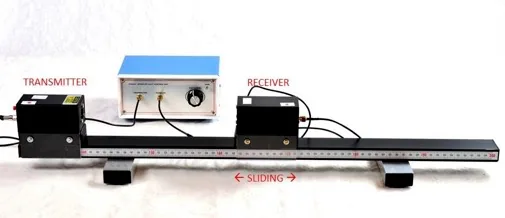
A laser beam is amplitude modulated. By moving the optical receiver along the optical bench, one determines the path length of the light when the phase rotation is zero, 180° or multiples.
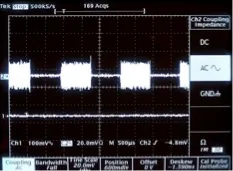
A second modulation of the laser beam at audio frequency allows the positions of the minima of the phase difference signals to be determined precisely by nulling the audio signal.
The high-frequency modulation f of the laser, which is about 1 GHz, is a precisely given instrumental parameter. The corresponding wavelength is 30 cm and the period T is 1 ns.
The laser modulation frequency is by far the highest used in this kind of measurement and allows the apparatus to be extremely compact.
Along the optical bench there are four receiver positions where the phase-shift signals are zero and therefore the audio signal of the monitor is zero. The distance between these successive positions is about half the wavelength of the modulating signal, i.e. about 15 cm.
Because of a possible asymmetry of the modulating waveform, the determinations of c are made by measuring the distance D between two non-adjacent minimum positions, corresponding to a whole wavelength of the modulating signal, about 30 cm.
Therefore:
c= D/T = D∙f
This device measures the distance travelled by light in 1 ns.
FEATURES
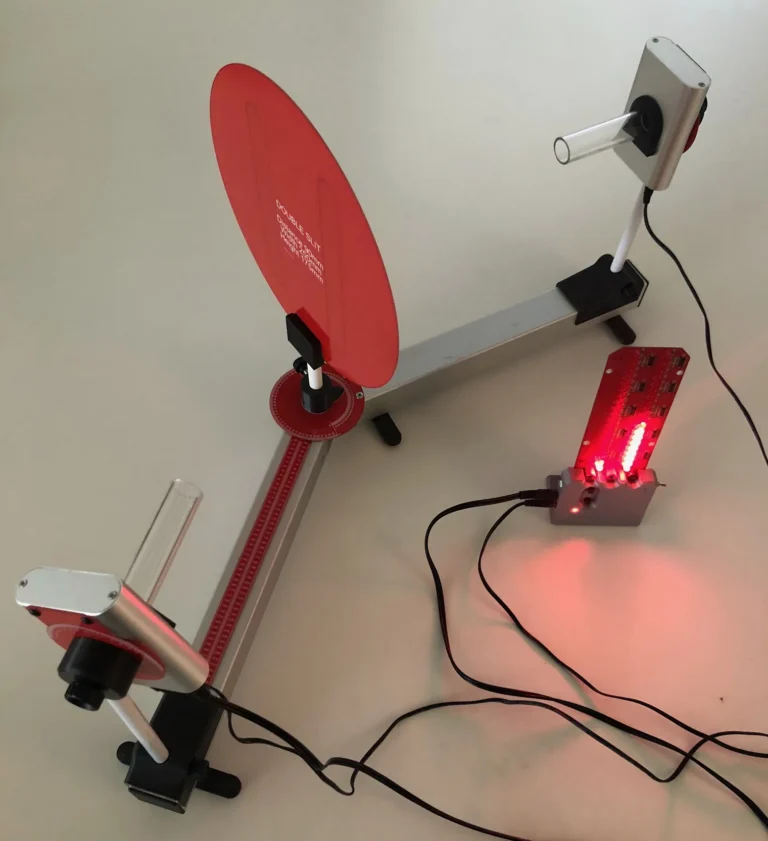
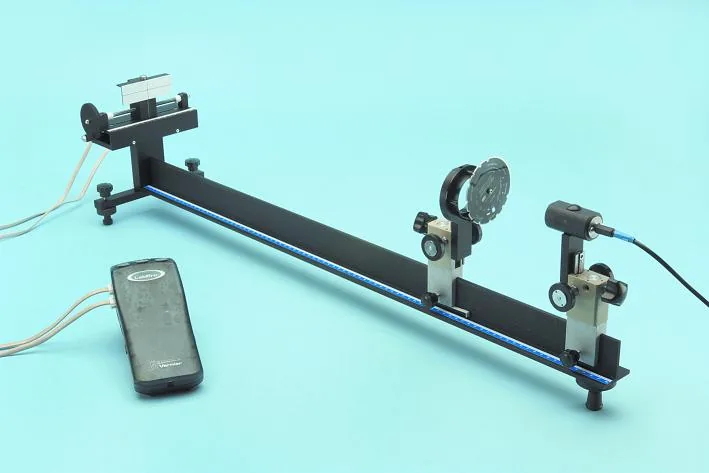
portable (it fits in a case plus a 70 cm long tube)
pre-aligned (no optical adjustment needed)
immediately operational (set up in less than a minute)
- does not require any external component or apparatus such as power supply, oscilloscope, lenses, holders etc.
- Device: compact, optical guide only 70 cmlong. Optionally only 40 cm
- safe: the 1 mW laser beam does not leave the optical path
- powered by an internal rechargeable battery via USB, lasting tens of hours
it also allows:
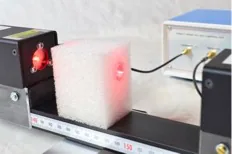
– measurements of the refractive index n in solids and liquids
– measurements of the velocity ratio in coaxial cables
The sensitivity is so high that it can detect the slowing of the light beam in the small thickness of a microscope slide (about 1 mm)
For a detailed description see: G. Pegna, An extraordinary tabletop speed of light apparatus American Journal of Physics 85, 712 (2017) (PDF, 2.5 MB)
Patented device
Larger versions, suitable for Museums or Science Centres, are available on request
Videos and documents
- AJP_SpeedOfLigh_Pegna.pdf (PDF, 2.5 MB)
Request a quote
info@labtrek.it · +39 333 337 9944