
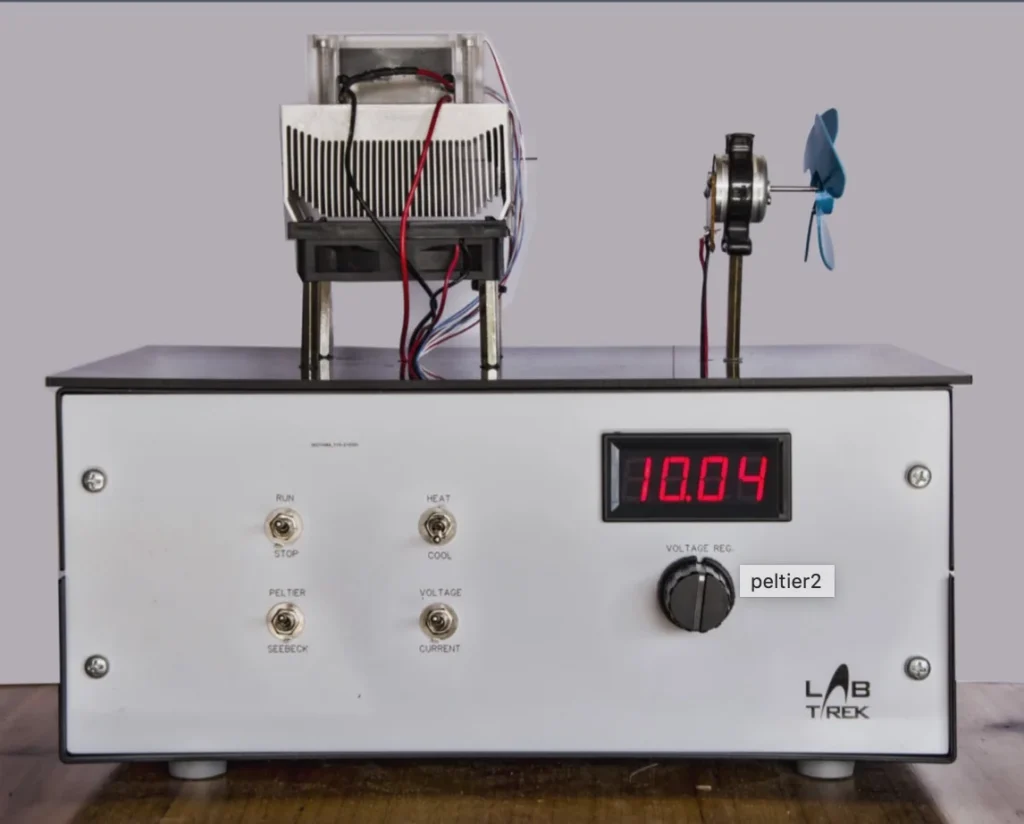
To see how it works: click here (Video, 22.1 MB)
The Peltier cell is an element, also called Frigistor, made of a series of junctions between different metals, which can work as thermocouples (that is, when the odd junctions are thermally anchored to a reservoir at temperature T1 and the even ones to a reservoir at a different temperature T2, an electromotive force appears across the series of junctions), but also as a heat pump (when a direct current flows through the junctions, they transfer heat from the face of the element to which the even junctions are thermally anchored to the opposite face, to which the odd junctions are thermally anchored).
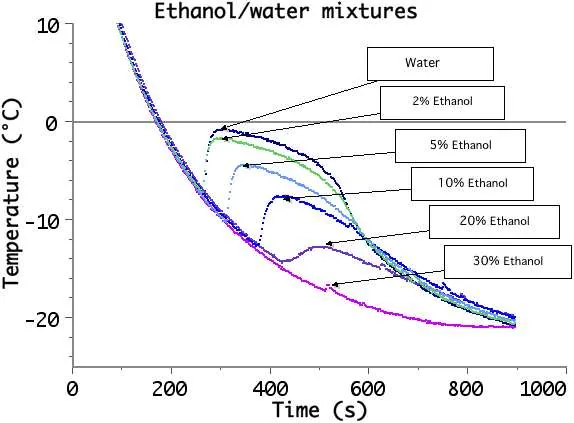
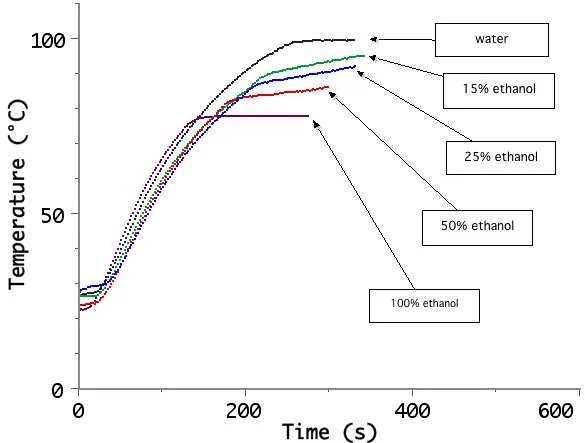
A teaching apparatus, designed to study the behaviour of a Peltier cell, can also be used to study various interesting thermodynamic processes: liquid-solid phase transition, supercooling, freezing point depression, measurements of the latent heat of fusion…
The apparatus consists of two coupled Peltier cells, powered in series, with the “hot” face cooled by a fan and the “cold” face coupled to an aluminium container (useful volume 10 cc).
Both the hot and the cold face have a housing for temperature probes, and a third thermometer measures the temperature of the liquid in the container.
The system is mounted on a base with a series of sockets to set up different measurement configurations, including the study of the efficiency of the cells as a heat pump or as an electric generator powered by a temperature gradient between two reservoirs, driving a small fan with a small d.c. motor.
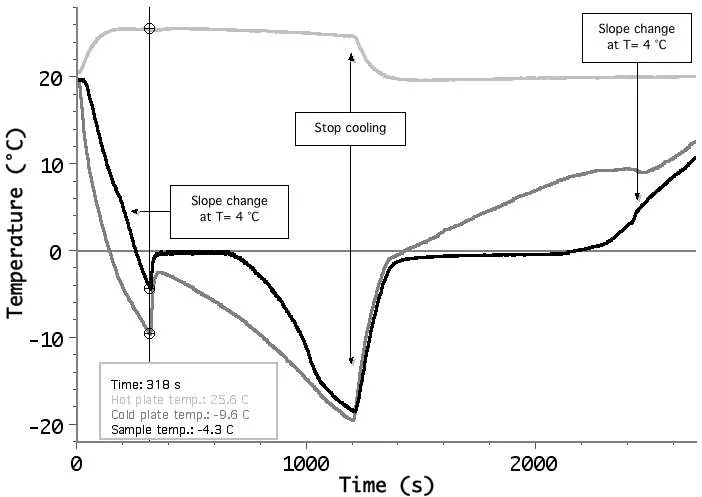
Example of a measurement of supercooled water: at time t=318 seconds the discontinuity in the graph of the water temperature shows the liquid-solid transition starting at T= – 4.3 degrees Celsius.
While ice forms in the whole volume of water, the temperature starts to fall slowly again (because of a non-zero temperature gradient), and when all the liquid has solidified (at t=1000 s) the slope dT/dt increases again.
From these data (knowing the mass of the liquid and of the copper reservoir and neglecting the heat capacity of the thermometer) a measurement of the latent heat of fusion of the liquid can be obtained (in the case shown in the figure the liquid is water).
By measuring the voltage and current delivered to a load (for example the fan driven by the small motor) when one face of the Peltier cell is heated, the efficiency of the process can be estimated.
By repeating measurements of the cooling of a liquid with and without an adiabatic cover (multilayer of aluminized mylar sheets) the importance of evaporation can be shown. Similar measurements without liquid reveal the importance of radiation.
Videos and documents
- Using Peltier cells to study solid–liquid–vapour transitions and supercooling (PDF, 0.5 MB) – G. Torzo, I. Soletta, M. Branca, Eur. J. Phys. 28 (2007) S13–S27
Request a quote
info@labtrek.it · +39 333 337 9944