
Teaching apparatus · Mechanics and oscillations
Planar pendulum studied with smartphone/tablet
at large and small amplitudes and with different types of friction
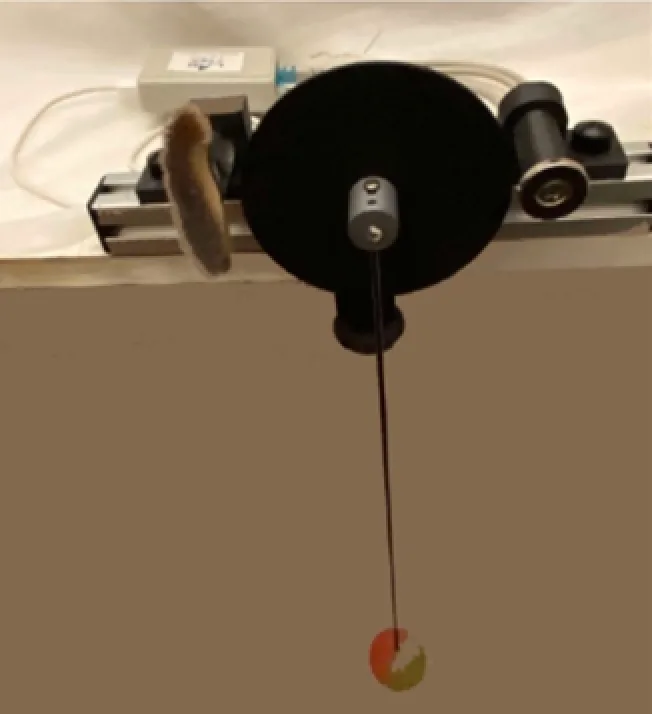
Experiments:
- the period of small oscillations does NOT depend on the value of the mass M (trying rubber balls of different diameters or with the disk attached),
- the period of small oscillations depends on the square root of the effective length (sliding the ball/disk along the rod)
- the period of large oscillations depends on the amplitude (the experimental data can be compared with theoretical predictions)
- damping is LINEAR for SLIDING friction
- damping is EXPONENTIAL for VISCOUS friction
- Export of the data to Excel™ for detailed analysis
Materials:
- datalogger with USB and bluetooth connection
- low-friction rotation sensor
- thin carbon fibre rod
- perforated rubber balls
- aluminium disks
- magnet mounted on a slide
- brush mounted on a slide
- aluminium rail, with a table vice
A simple teaching tool that uses real-time data acquisition via smartphone or tablet and a pendulum coupled to a low-friction rotation sensor, with variable effective length and mass, and with two different types of adjustable damping: “sliding” friction and “viscous” friction (proportional to the angular velocity).
A dedicated datalogger allows the Phyphox App for Android-iOS to be used to acquire the data, which can be transferred to a PC for detailed analysis.
The experiments can consist in the study of different behaviours of the system:
1) Study of the period of small oscillations (harmonic motion).
– Dependence of the period on the value of the mass M. For this purpose the pendulum can be loaded with rubber balls of different sizes, or with disks.
– Dependence of the period on the length L. For this purpose the masses (ball or disks) are slid along the rod.
2) Study of the period of large oscillations (anharmonic motion).
When the maximum elongation of the pendulum (amplitude) exceeds about 10°, the behaviour of the pendulum becomes particularly interesting for intermediate or advanced students.
– On the one hand, the period depends on the amplitude and the oscillations of the pendulum are no longer harmonic.
– Many properties of the system related to its non-linearity become evident, and this poses new challenges to its study.
– This device is particularly suitable and flexible for this kind of study, whose results can be compared with different theoretical models.
3) Analysis of the motion for different types of damping.
– Study of the motion with sliding friction. A LINEAR decrease of the amplitude with time is observed. The amount of this damping can be varied.
– Study of the motion with viscous friction, i.e. proportional to the velocity. An EXPONENTIAL decrease of the amplitude with time is observed. The amount of damping can be varied.
The experimental apparatus
In this device we use an angular sensor connected to a dedicated datalogger with bluetooth and USB connections, which can be controlled by a PC or by a smartphone o tablet.
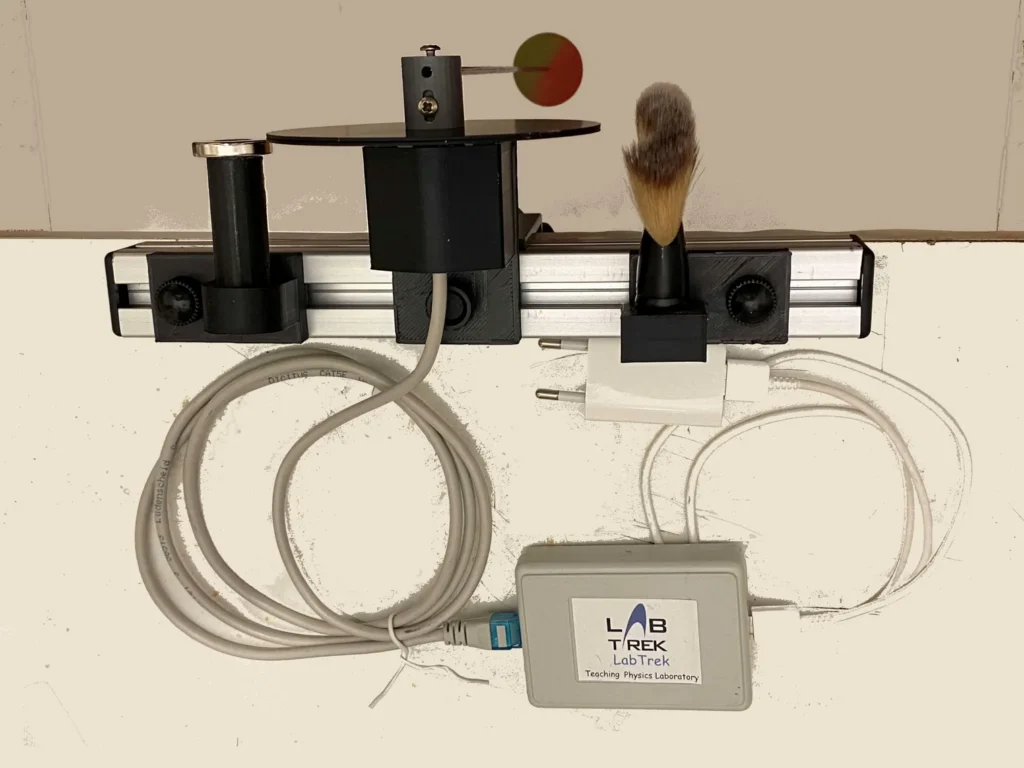
The elements that make up the device are: datalogger, rotation sensor, rod, rubber ball, aluminium disks, magnet mounted on a slide, brush mounted on a slide. The sensor and the two slides are mounted on an aluminium rail, with a vice that allows it to be fixed to the edge of a table (see Figure 1).
The pendulum consists of a rubber ball threaded on a thin rod (carbon fibre) fixed to the shaft of an angular sensor with very low friction.
To study both viscous and slidingfriction, the sensor shaft carries an aluminium disk. In this way the oscillation of the pendulum can be damped by a braking torque MR produced by two types of forces: a viscous force produced by a magnet facing the disk (the eddy currents due to the relative motion of disk and magnet produce a braking torque proportional to the angular velocity MR = –γω), or a constant braking torque (sliding friction) produced by a soft brush touching the disk MR = –A sign(ω).
– The intensity of each friction torque can be varied by adjusting the position of the magnet or of the brush with respect to the disk.
– The effective length of the pendulum can also be changed by sliding the ball along the rod.
– Finally, the value of the mass M can be changed by changing the type of rubber ball or disk fixed to the rod.
Using phyphox for data acquisition
LabTrek has developed an application for Android and iOS based on the PhyPhoxapplication, which can be downloaded free of charge from the internet.
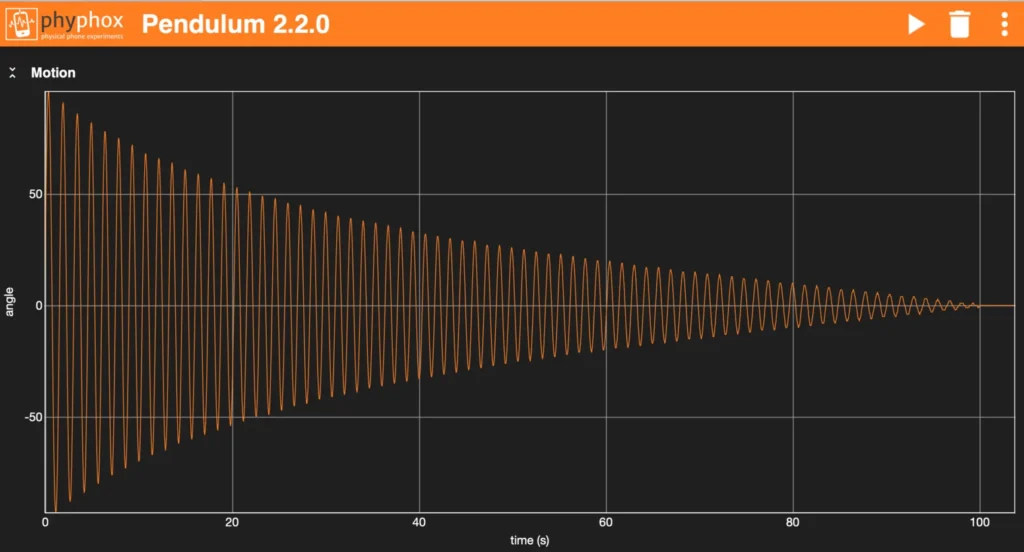
Acquisition of free oscillations (viscous friction of air only)
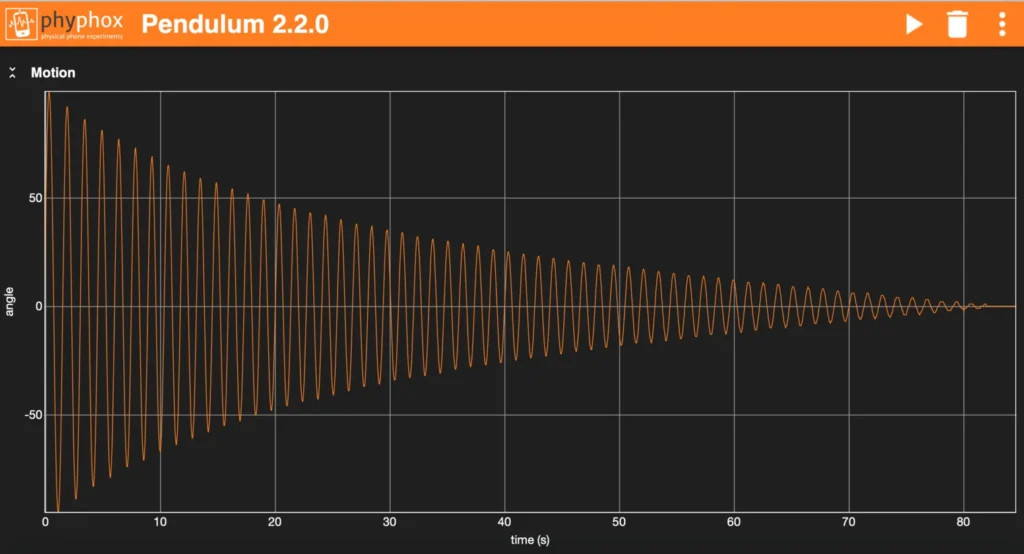
Acquisition of oscillations with the magnet (higher viscous friction)
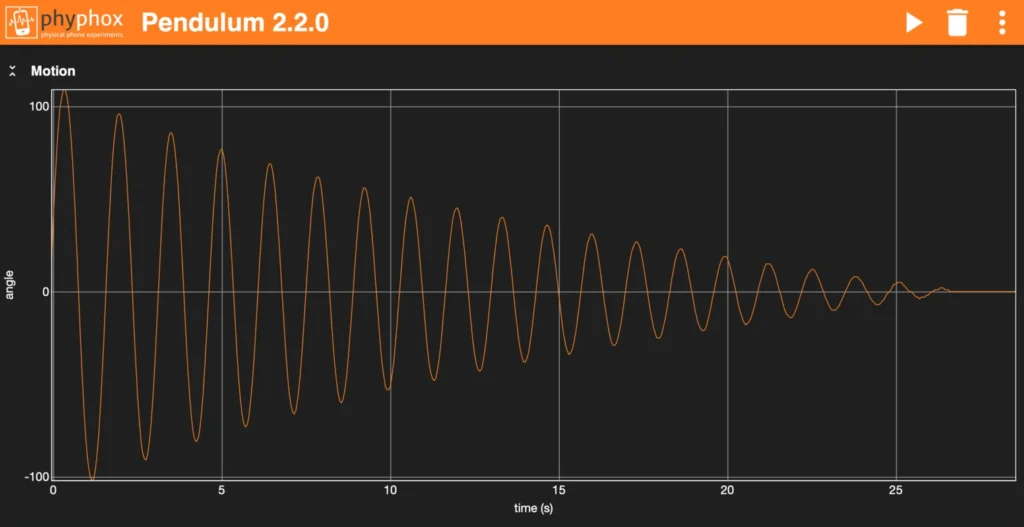
Acquisition of oscillations damped by the brush (sliding friction)
Planar pendulum studied with smartphone/tablet data sheet (PDF in English, 1.5 MB)
Request a quote
info@labtrek.it · +39 333 337 9944