
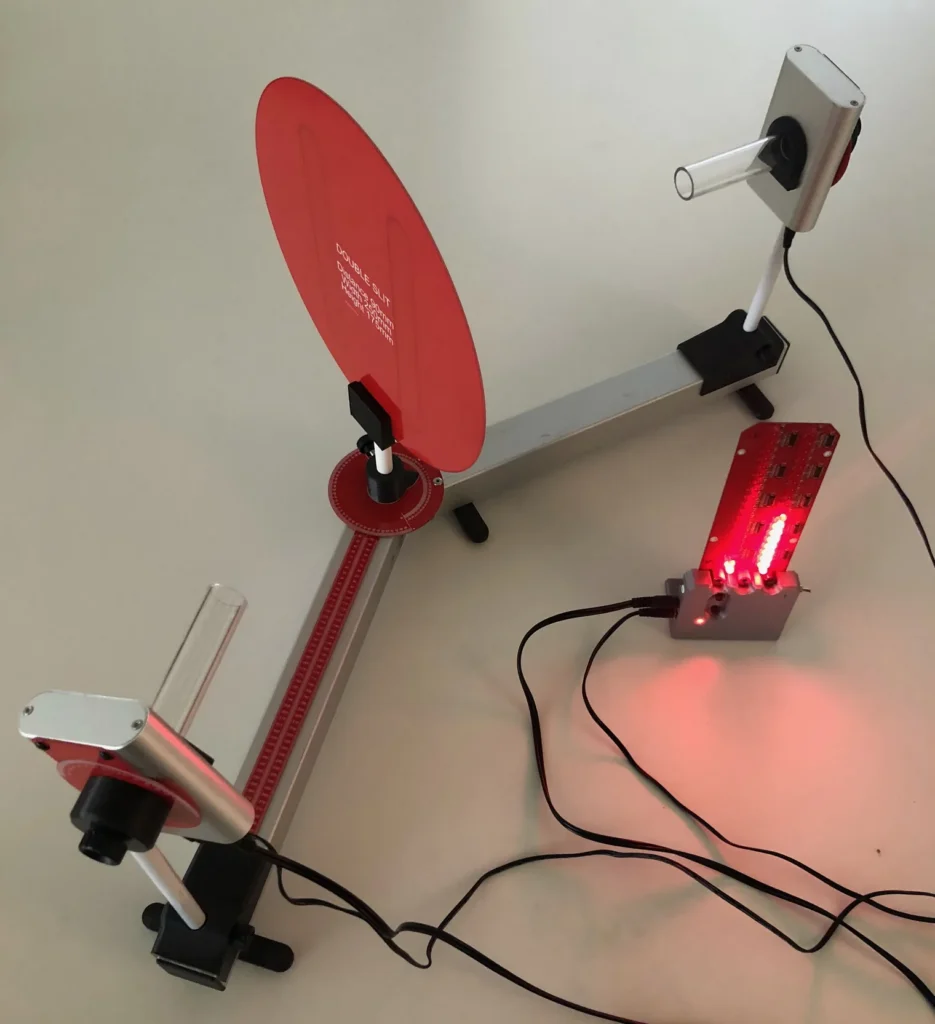
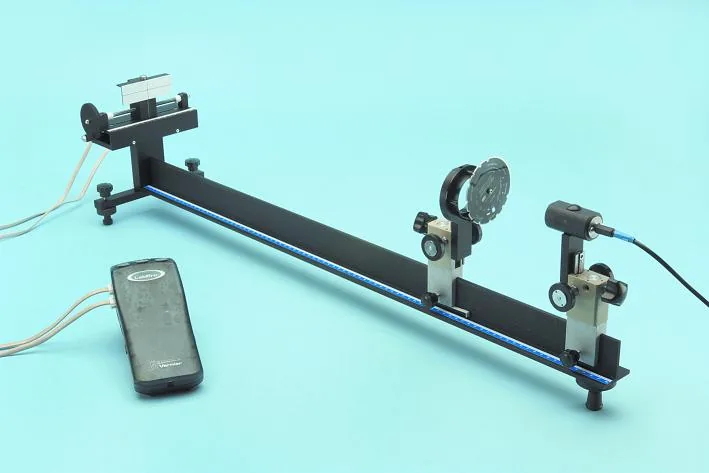
- Bench length: 1 m. The angle between the two 50 cm long arms is variable and can be read on a protractor.
- Frequency: 10 GHz, wavelength 3 cm, vertical polarization in the normal working position. The polarization can be rotated by 90°.
- Transmitted power: less than 5 mW.
- Special tubular dielectric antennas give strong directionality and minimum bulk.
- Radiation safety: the microwave radiation is well below the safety standard set by the regulations for public exposure, such as ANSI C95.1-1991 (USA) and NRPB-11 (England).
- The bench, the slides and the vertical holders (riders) are metal or plastic parts that ensure precise positioning and easy sliding of the various “optical” elements.
- Rotating holders: transmitter and receiver can rotate through 360°, an important feature for experiments on polarization.
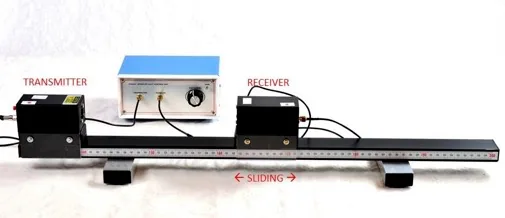
- Receiver: 200 MHz super-heterodyne, manual sensitivity control in the range 1:20.
- Detected signal reader: two-channel instrument with 20 LEDs each, and audio outputs with intensity proportional to the received signal, useful for classroom demonstrations.
- 12 V d.c. wall power supply
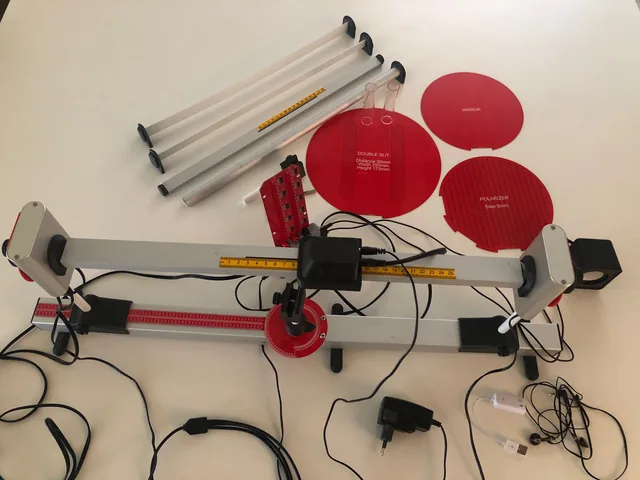
Demonstrations and experiments
List of experiments, demonstrations and possible studies of the properties of microwaves and of their interaction with matter.
- Measurements of absorption by various materials: a hand, sheets of plexiglas, polycarbonate, nylon, PVC, wood, cardboard, hardboard, concrete etc.
- The law of reflection from a conducting surface. A corrugated metal mirror is supplied as an example.
- Refraction: excellent focusing of the microwave beam with a paraffin lens.
- Polarization: determination of the direction of the electric field vector with a grid of parallel metal wires (spaced less than half a wavelength apart). Malus’s law (cosine squared).
- Reflection from a dielectric surface. Transmission as a function of the polarization and of the orientation of the guide.
- Brewster’s angle and polarization of the reflected and transmitted beam.
- Quick determination of therefractive index of various materials at a frequency of 10 GHz.
- Study of standing waves with a dielectric plate that can be moved along the direction of propagation. Precise measurements of the wavelength.
- Young’s experiment (double slit) with detection of the maxima and minima in the diffraction spectrum. Covering one of the slits (for example with a hand) the received signal goes to zero even in the strongest zero-order maximum.
- Metal waveguides cylindrical and rectangular, of various sizes. Cut-off dimensions. Polarizing properties. Attenuation.
- Measurements of distribution of the electric field inside a slotted rectangular metal guide with a diode sensor. The maxima and minima of the standing wave can be detected, as well as the phase velocity, which is always greater than c.
- Dielectric waveguides: in PVC and acrylic, of various shapes. Strips, bars, cylindrical and rectangular tubes. Demonstrations of the absence of cut-off. Attenuation.
- Evanescent wave in a dielectric waveguide. Measurements of the exponential decay of the intensity as a function of the distance from the guide with a diode sensor, micrometric translator and millivoltmeter.
- Fabry-Perot interferometer. Moving a mirror you see high-contrast fringes, where the positions of maxima and minima can easily be measured, and so the wavelength can be measured precisely.
- Faraday effect. A demonstration of the rotation of the plane of polarization, which can reach the remarkable value of 90° with a small ferrite bar in a magnetic field of a few tens of gauss.
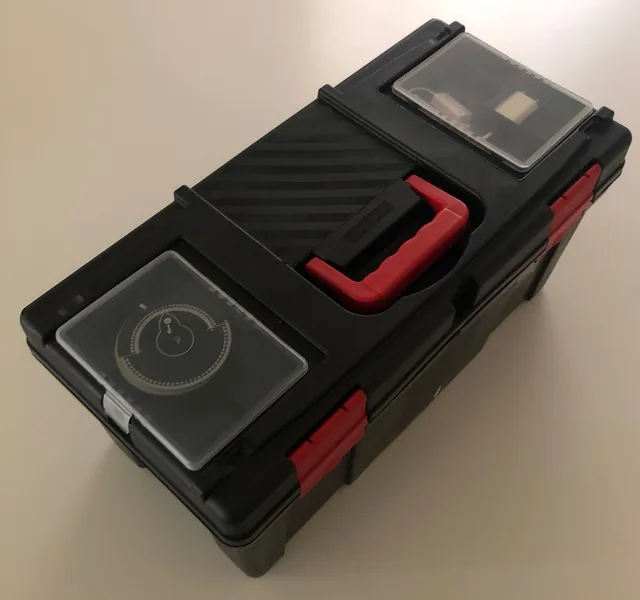
The dismantled bench is shipped in, and can conveniently be stored in, a plastic box
Request a quote
info@labtrek.it · +39 333 337 9944