
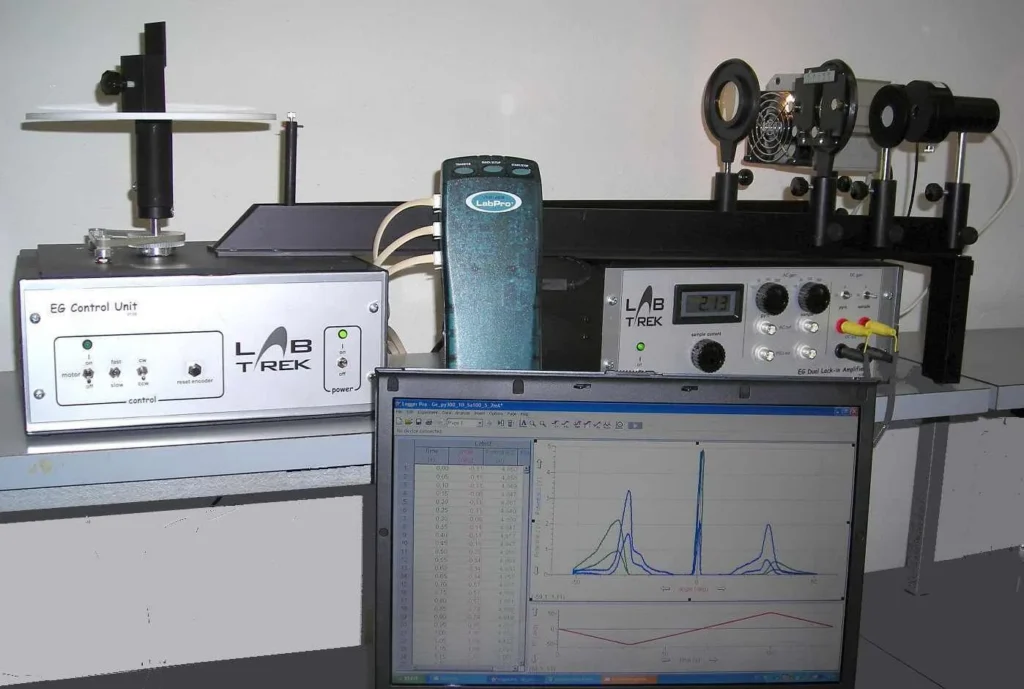
The theory of electronic energy bands is particularly important for understanding the properties of condensed matter and, in particular, the measurement of the energy gap can be considered an essential step in learning solid state physics.
In this experiment we aim to obtain an estimate of the energy gap of semiconductor materials (Ge and Si) at room temperature, producing electron-hole pairs through the internal photoelectric effect.
The experiment consists in directing a beam of monochromatic light onto a semiconductor sample and measuring, as a function of the wavelength λ of the incident light, both the change in resistance of the sample (photoconductivity) and the intensity of the light it transmits.
The lamp has an emission spectrum ranging from the visible to the near infrared. The first lens is placed in the light path so as to make parallel the light beam that falls on the reflection diffraction grating.
The emerging beam is focused on the sample by a second lens.
By rotating the grating with a geared motor, the wavelength of the light falling on the sample changes as the angle R changes.
The change of angle is detected by an angle sensor that measures the rotation relative to the initial position.
A high-pass optical filter is used to remove spectra of order higher than the first.
The sample is a few tenths of a millimetre thick, to allow a sufficiently intense beam to be transmitted, and its resistance depends on the density of electric charge carriers: the voltage across it is therefore modulated by the incident light for λ<λs (photoconductive sensor).
The pyroelectric sensor is placed behind the sample and measures the amount of transmitted light.
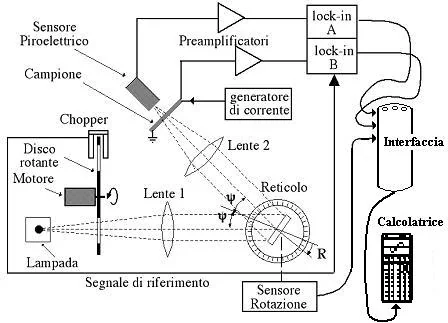
Both signals, transmitted light and photoconductivity, are preamplified and made immune to noise and ambient light by a two-channel lock-in, driven by the reference signal taken from a chopper.
The interface, connected to a PC through a serial port, allows direct acquisition of the signals produced by the 3 sensors.
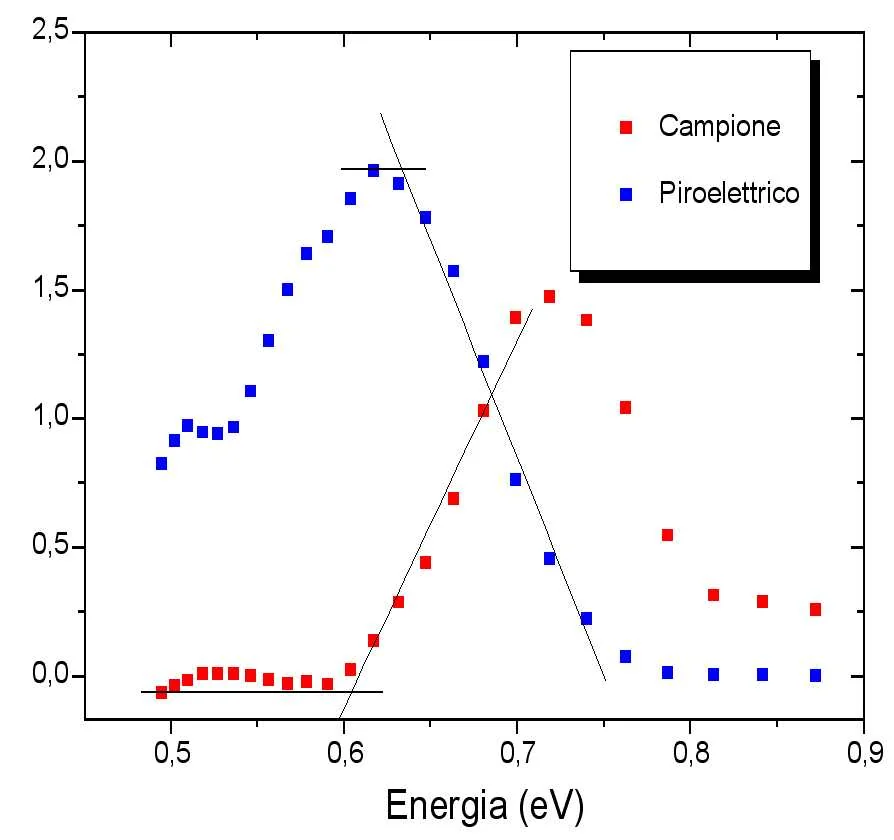
It is easy to convert wavelength values into energy values: E=hc /λ where h is Planck’s constant and c is the speed of light.
The graph shown here plots the photoconductive signal (in blue) and the signal proportional to the intensity of the transmitted light (in red): the energy gap values are obtained by marking the background of the signals in the lower-energy region (longer λ) with two horizontal lines and fitting the rising and falling edges with two lines; the intersections of the sloping lines with the horizontal ones give the two threshold values, i.e. the minimum energy at which the photoelectric effect begins.
Experiments that can be performed:
- Determination of the Energy Gap of a semiconductor: by measuring photoconductivity
- By measuring light transmission
Supplied material:
- Double alignment rail
- Incandescent lamp with chopper
- Focusing lenses
- Diffraction grating on goniometer
- Angle sensor
- Optical filters
- Thin Ge and Si samples (photoconductive sensor)
- Pyroelectric sensor
- Measurement circuit
- Cables
Required material not supplied:
- PC or calculator
- Interface
- Oscilloscope
- Data acquisition software
Semiconductors and solid state
See also
Request a quote
info@labtrek.it · +39 333 337 9944