
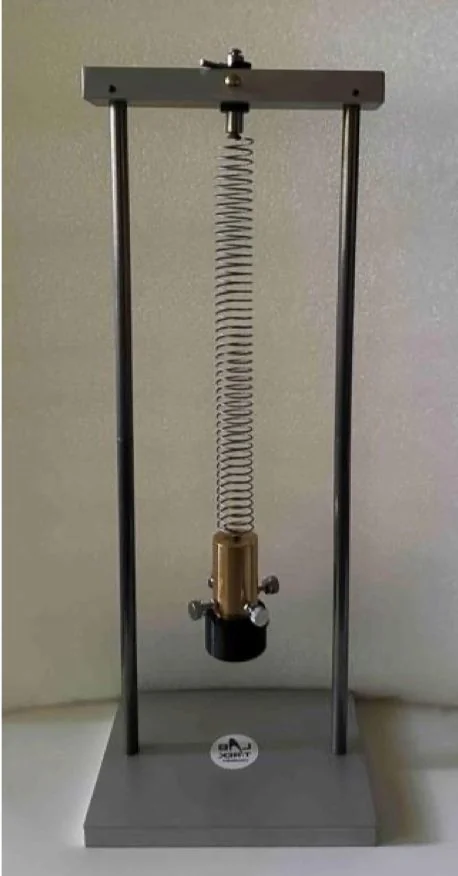
Pendulum studied with Phyphox and smartphone or tablet or Coach7
The aim of this experiment is to analyse the motion of a mass-spring pendulum, called the Wilberforce pendulum, in which a particular choice of parameters produces a coupling between translational and rotational motion.
This apparatus has a MEMS accelerometer/gyroscope and uses the free software Phyphox to show the motion of the device on the screen of a smartphone/tablet.
Processing the data acquired in real time and exported to a spreadsheet shows the various components of the energy associated with the oscillations (kinetic and elastic-potential, for both the vertical and the torsional oscillation, and finally the coupling energy of the two motions) and allows a comparison with numerical simulations.
A detailed analysis of the components of the pendulum’s motion will show that they are characterized by two distinct frequencies, due to the coupling of different oscillation modes that can be excited depending on the choice of initial conditions.
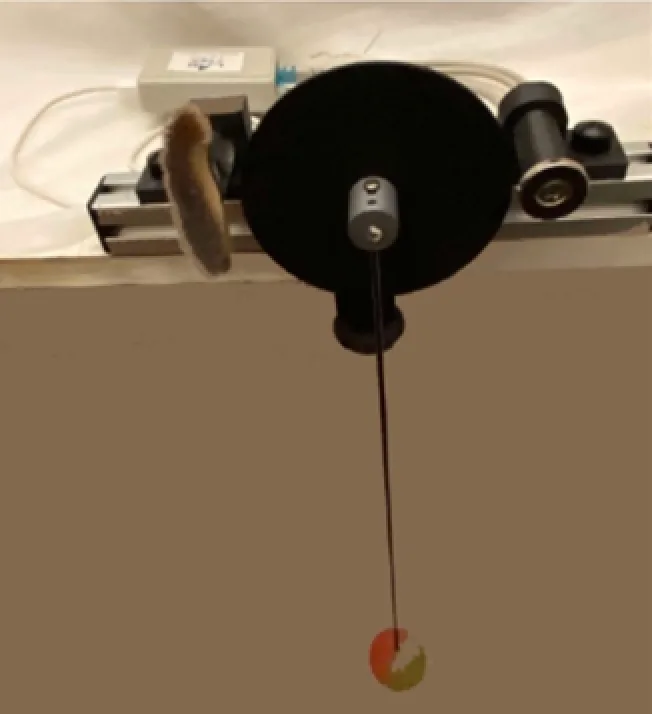
The pendulum consists of a spring and a brass cylinder. The cylinder is fixed to one end of the spring, while the other end is fixed to a rigid support. The translational motion is recorded by a MEMS device connected to a datalogger that connects to Phyphox via Bluetooth.
Depending on the initial conditions (for rotation and translation) the motion of the pendulum can evolve in different ways: beats or pseudo-stationary roto-translations.
Figure 2 shows the <beat> mode: the vertical oscillations slowly die out as the amplitude of the rotational oscillations increases, then the process reverses (about every half minute) and the exchange of energy between the two motions continues. From the measurements of the displacement z and of the rotation angle α one can obtain the time behaviour of the total translational energy ET and of the total rotational energy ER:
ET = EkT + EeT = (m/2)v2 + (k/2)z2
(with m mass, v=dz/dt translational velocity and k elastic constant).
ER = EkR + EeR = 1/2 I ω2 + (D/2) α2
(with I moment of inertia, ω=dα/dt angular velocity and D torsion constant).
A suitable choice of the ratio between initial angle and displacement removes the beats: the energy is shared equally between translation and rotation (pseudo-stationary fundamental mode), as shown in figure 3.
LabTrek produces two versions of the Wilberforce pendulum: one for science museums, robotized with actuators driven by an Arduino board (a magnetic actuator stops the motion to change the dynamic regime without touching the pendulum), and a manual one for teaching laboratories; both make it easy to produce the three different motions (beats, left-handed roto-translation and right-handed roto-translation)
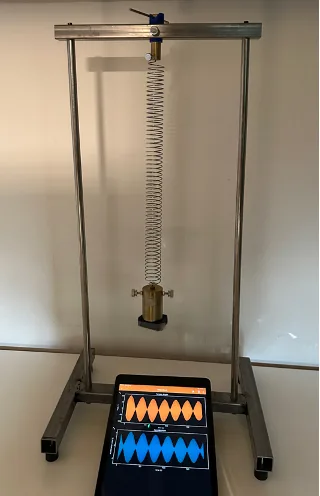
Figure 1: the pendulum
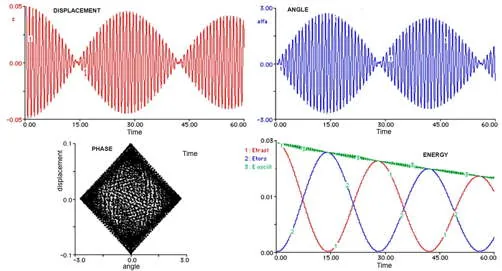
Figure 2. mode: beats
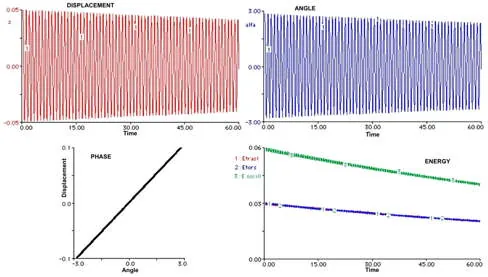
Figure 3. fundamental mode: stationary roto-translation
Experiments that can be performed:
Analysis of the motion of the pendulum
Study of the coupling of the 2 oscillation modes
Supplied material:
Removable pendulum support
Pendulum with MEMS sensors and datalogger
Teaching material included:
Student guide to the experiment
Teacher’s manual
(see: G. Torzo, M. D’Anna, M. Zanichelli, Computational Modeling, a case study: the Wilberforce pendulum (PDF, 1.0 MB), Journal of Physics: Conference Series 3280 (2026) 012016, GIREP-EPEC 2025 Conference)
(see also: G. Torzo, M. Zanichelli, S. Pasqualotto, M. D’Anna, The Wilberforce pendulum: a complete analysis using micro accelerometer/gyroscope, smartphone and dynamical modeling (PDF, 1.2 MB), Lat. Am. J. Phys. Educ. Vol. 19, No. 4, March 2025)
Videos and documents
- WilberLABTREK.pdf (PDF, 0.5 MB)
Video showing a short test of the Wilberforce pendulum using Coach7
Request a quote
info@labtrek.it · +39 333 337 9944