
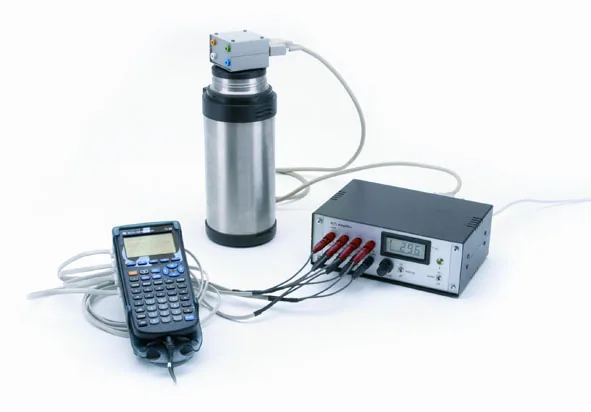
The apparatus allows the study of the behaviour of resistivity as a function of temperature for metals and semiconductors in the temperature range from T=80K to T=450K. Simultaneous acquisition of the signals from different samples shows the different behaviours in real time: monotonic for metals, where the density of charge carriers is constant, almost linear and then falling exponentially for semiconductors, where electron-hole pairs are generated thermally. Analysis of the data obtained with semiconductor samples also allows the determination of Eg(0), the value of the energy gap linearly extrapolated to T=0K.
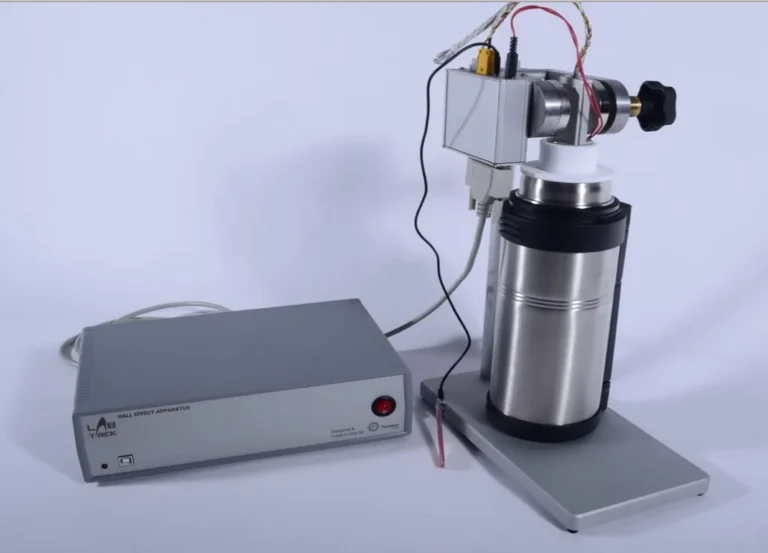
In the box placed above the dewar, four sockets allow the resistances to be measured with an ohmmeter. It is easy to verify that the volt-ampere method used by an ordinary ohmmeter to measure a resistance connected between its two terminals always overestimates the real value of the resistance.
Experiments that can be performed:
- study of the behaviour of resistivity as a function of temperature
- determination of the energy gap Eg(0) extrapolated to T=0K
- comparison of volt-ampere measurement methods: 2-terminal, 4-terminal, 4 separate contacts
Supplied material:
- dewar
- sample holder heater
- 3 samples
- terminal block for signal input/output
- control unit with display
- cables
Required material not supplied:
- PC or calculator
- Interface
- Data acquisition software
- ohmmeter
Teaching material included:
- Student guide to the experiment
- Teacher’s manual
Description of the experimental procedure
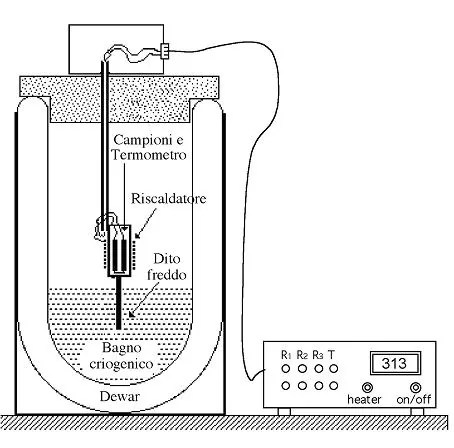
The samples are placed inside a small metal cylinder with a heater and a cold finger: 3 samples can be analysed at the same time.
The temperature in the sample-holder cylinder is measured with a diode thermometer and shown in kelvin on a three-digit LCD display on the front of the control box. The resistance is measured with the four-terminal volt-ampere method for the metal samples, and with the 4 separate contacts method for the semiconductor samples.
If the temperature exceeds 420 K an electronic threshold switch turns off the heating, to avoid damaging the apparatus.
Analysis of metal samples
For metals the electrical resistance always increases with temperature according to an approximately linear relation: R = Ro(1+at), where Ro is the value at zero degrees Celsius and a=dR/(Rodt) is called the temperature coefficient of the metal.
For a cylindrical, uniform and homogeneous conductor the resistance is R(T)=4 rho(T)L/piD2, where rho is the resistivity, A the cross-section, D the diameter and L the length.
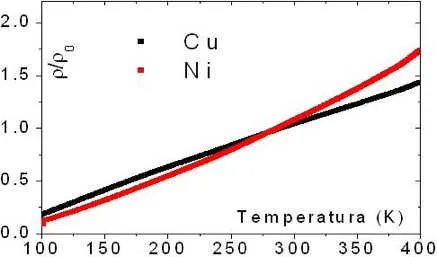
If you plot rho/rho0 (rho0 resistivity at T=273K) as a function of temperature, you see two different behaviours for the two metals: linear for copper and quadratic for nickel. The behaviour of metals at high T can be described, to a first approximation, by the relation rho1(T)=bT, with b=constant, and is confirmed by the analysis of the experimental data for copper.
The case of Nickel is slightly different because, compared with Copper, the Debye temperature of the Ni crystal, TD, is higher: at T comparable with TD the mechanism that controls the mobility of the carriers, and therefore the resistivity of the metal, is inelastic phonon scattering, which gives the behaviour rho(T)~T5.
Analysis of semiconductor samples
The experiment is more interesting for semiconductors, because an N-doped semiconductor behaves as extrinsic or intrinsic depending on whether the emission of carriers from the donor atoms or the direct excitation of electrons into the conduction band prevails. While for metals the electron density n is practically constant as the temperature changes, so only the mobility can affect the conductivity, for semiconductors the behaviour of the conductivity as a function of temperature depends both on the concentration of free carriers n and on their mobility µ. The figure shows the experimental data for the resistance of Ge as a function of temperature.
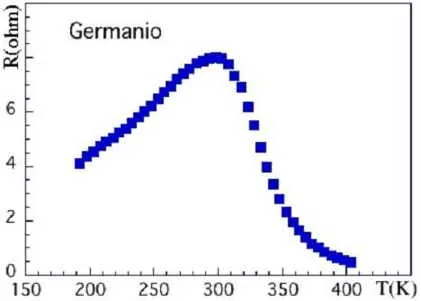
At low temperatures (extrinsic regime) the electrical conductivity is essentially determined by the carriers due to the dopant, whose concentration is constant as the temperature changes, while the contribution of intrinsic pairs is negligible: the behaviour is similar to that of a metal and the conductivity depends on temperature essentially like the mobility µ.
As T increases, the number of intrinsic carrier pairs grows rapidly according to the law ni= const exp[-Eg/(2kT)], until the opposite condition is reached (intrinsic regime) in which the dopant has a negligible effect. In this temperature range the graph of ln(R) vs. 1/T is a straight line with slope Eg/(2k): from the slope of the line one obtains Eg(0)=0.79± 0.02 eV; a result comparable with the commonly quoted value of the energy gap of Ge extrapolated to T=0K, that is Eg(0)=0.78 eV
See also: An undergraduate laboratory experiment for measuring the energy gap in semiconductors (PDF, 0.4 MB), Eur.J.Phys. 10, 123 (1989)
Semiconductors and solid state
See also
Request a quote
info@labtrek.it · +39 333 337 9944